Sunday, 20 April 2014

Day 8: Exploring Kyoto

Today is our last full day in Kyoto, so time to do some independent exploring.

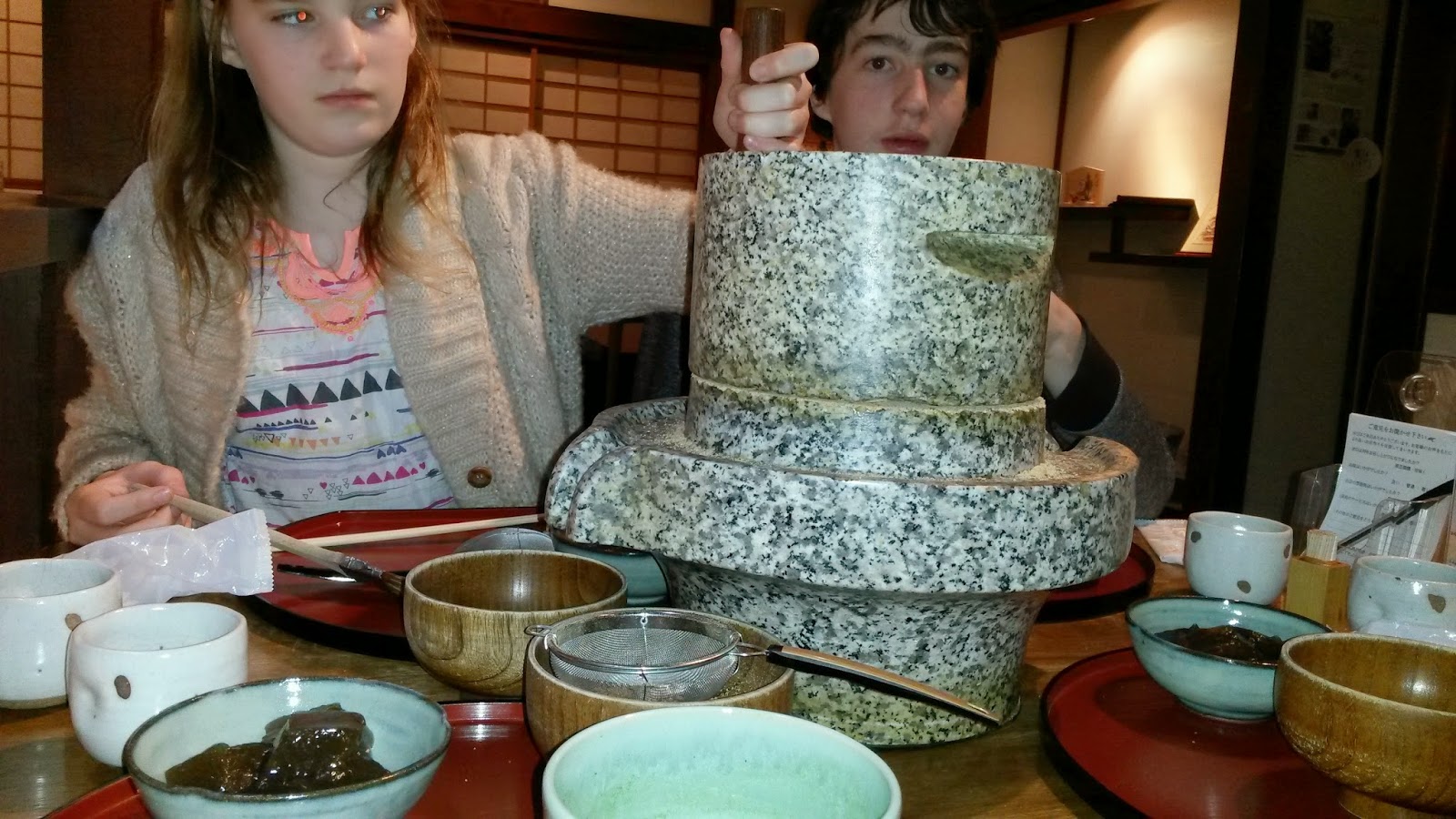
We headed back to the market which we'd passed through on the way to the Tea ceremony yesterday, wanting to look for some souvenirs and snacks for the next day's journey. Hungry work, so we stopped at a cafe specialising in soy beans, for a slightly mysterious meal, until we worked out how to use the grinder for the roasted soybeans :

Delicious with green tea.

Next another garden - Shosei-en - only a couple of city blocks but improbably described in Inside Japan's notes as "huge", and indeed it turned out to be just that. You could quite easily forget you were in the middle of a busy city, with a lake, bridges, tea houses and stone lanterns forming many garden "rooms" to explore.
.

:

and at least one potentially aggressive bee


A pity the cherry blossom had finished here too.
Ambling back to the hotel we passed a procession celebrating a Spring festival, with Buddhist monks and others on the back of lorries garlanded with wisteria.


After yesterday's failed attempt to find Musashi Sushi, today we hit paydirt having done our research. Turns out it's in another shopping complex within Kyoto station that we hadn't yet explored. We take our place in the queue and wait for some spaces at the counter to become available; the chances of 5 seats together being pretty slim we settle for a 2 and a 3 and get down to the serious business of choosing which plates to pick off the conveyer belt.

Green tea on tap, and lots of tempting plates

At about ¥150 a plate (very roughly £1), it's easy to be indulgent. The standard and variety of choice is way above that of UK chains like Yo Sushi.


Tomorrow we leave Kyoto for Hiroshima and Miyajima, so once again we're making use of the excellent baggage forwarding services to have our suitcases shipped to our next big city destination (Osaka) while we travel light for a couple of days.

Saturday, 19 April 2014

Day 7: Pottery Class, Tea Ceremony

Breakfast at the hotel; much more westernised than we've encountered thus far.

After breakfast we meet our guide for the day, who asks us what we like about Japan. We mention a number of things, including Studio Ghibli, not realising that she will use this information later!

After getting our day passes for the Kyoto buses (there isn't much of a subway system in the city, so to get anywhere you really need to take either a bus or a taxi), our guide takes us to Kinkaku-ji (also known as the Golden Pavilion).


The temple (amongst many other things) was the setting for Mishima Yukio's notorious novel The Temple of the Golden Pavilion, which was inspired by the burning of the temple by a young Buddhist in 1950 (an event which profoundly shocked Japan). Today it's a serene place oblivious to the many tourists gathering around it, and making use of the "borrowed scenery" style of Japanese landscaping.

We were pleased to see an ex-bonsai tree; its original owner having died a couple of centuries ago, it had been allowed to grow free ever since (although in its extreme old age it needs some support these days).


We catch a bus (actually 2 buses) back towards the centre of the city, busy, and not as punctual as we have grown to expect of public transport in Japan. After a quick (but delicious) noodle lunch (including further instruction as to how to properly eat noodles - dip them in the stock and slurp away, the slurpier the better), we make a dash for our Tea Ceremony appointment. Our hostess takes us through the steps of the ceremony (although at around 10 minutes, it's a highly condensed version of what can take more than an hour), and we're all surprised to learn that the tea is mixed with a bamboo whisk that renders it somewhat frothy in nature.


Suitably relaxed, we then walk through some of the delightful back streets of Kyoto.

Suddenly, we stumble upon a very familiar figure, and this is when we realise our guide has been taking careful note of what we told her earlier - the somewhat pensive (but friendly) Totoro below sits outside a shop that specialises in all things Ghibli; 20 minutes later I have completed my collection of all 3 Totoros and we have acquired several other delightful bits of memorabilia.

ありがとう!

It's ok Totoro!


Having been dragged away from the Ghibli shop, there's time for a brief visit to a sweet factory before we head for our pottery lesson. Our instructor gets us set up behind our pottery wheels and does a good job of explaining to five ingenues how to go about fashioning something out of clay.


All in all the results are perfectly respectable, and worth the effort of having them glazed and shipped to us.


For supper tonight we attempt to find Musashi Sushi; a highly regarded kaitenzushiya (conveyer belt sushi) restaurant located somewhere in Kyoto station. 45 minutes later we admit defeat and end up at fast food place instead (although it has to be said, such establishments are vastly superior to their UK counterparts). Still, we shall not be defeated - maybe tomorrow night we will manage to find it (with a bit of Googling back at the hotel this evening).

All 3 Totoros, chilling out

Friday, 18 April 2014

Day 6: Kyoto


This morning we leave our ryokan in Tonosawa to catch the train back to Odawara; a light drizzle this morning but nothing to dampen the spirits.

Such a shame that we'd missed the cherry blossom here too.


We tarry a while in Odawara to visit the castle there; my stoicism in the face of what is now a respectable rain storm is put to the test, and Rachel takes pity on me to go and buy an umbrella (the chap in the gift shop offers his for us to borrow).

Like most ancient buildings in Japan, the original wooden structure is long gone, but the castle has been sympathetically recreated.

Samurai Sam
Imogen and Samuel took the opportunity to get kitted out in traditional Japanese dress; Imogen would probably have preferred to don Samurai costume too, but looked very much the part in her attire.

We return to Odawara station to grab some lunch from a splendid patisserie at the JR station, and then board the Shinkansen to take us on to Kyoto.
Going native

We thought we'd find our hotel easily, it being located in Kyoto railway station, but the station is massive, including many shopping complexes arranged on multiple levels. After getting some help (not least from the children, whose first suggestion turned out to be right after all) we finally find it, but even then the hotel is so large walking down the corridors to find reception takes several more minutes.

Finally we check in, cheered to discover that our bags have arrived safe and sound and are waiting for us - hoorah for the takuhaibin.


We have a splendid view of the bustling Kyoto station from our hotel room.


We've become perhaps a little blase about the sophistication of Japanese toilet technology, but our hotel room in Kyoto had further delights in store for us:


Supper tonight at the tempura restaurant that's part of the hotel; beautiful tempura, light and crisp batter, all very elegantly presented.

Thursday, 17 April 2014

Day 5: Around Hakone - open air art & ropeway

After a lovely, albeit rather substantial, breakfast at our ryokan we set out to take in some of the attractions; the first stop is a short walk to Hakoneyumoto railway station (we'll discover later there is a much closer station), passing through the charming sights stretched out along Highway 1 (the main drag through the mountains).

Using our trusty JR passes, we catch the train to
Chokokunomori Station, from which a short walk brings us to the Hakone open air art museum. 

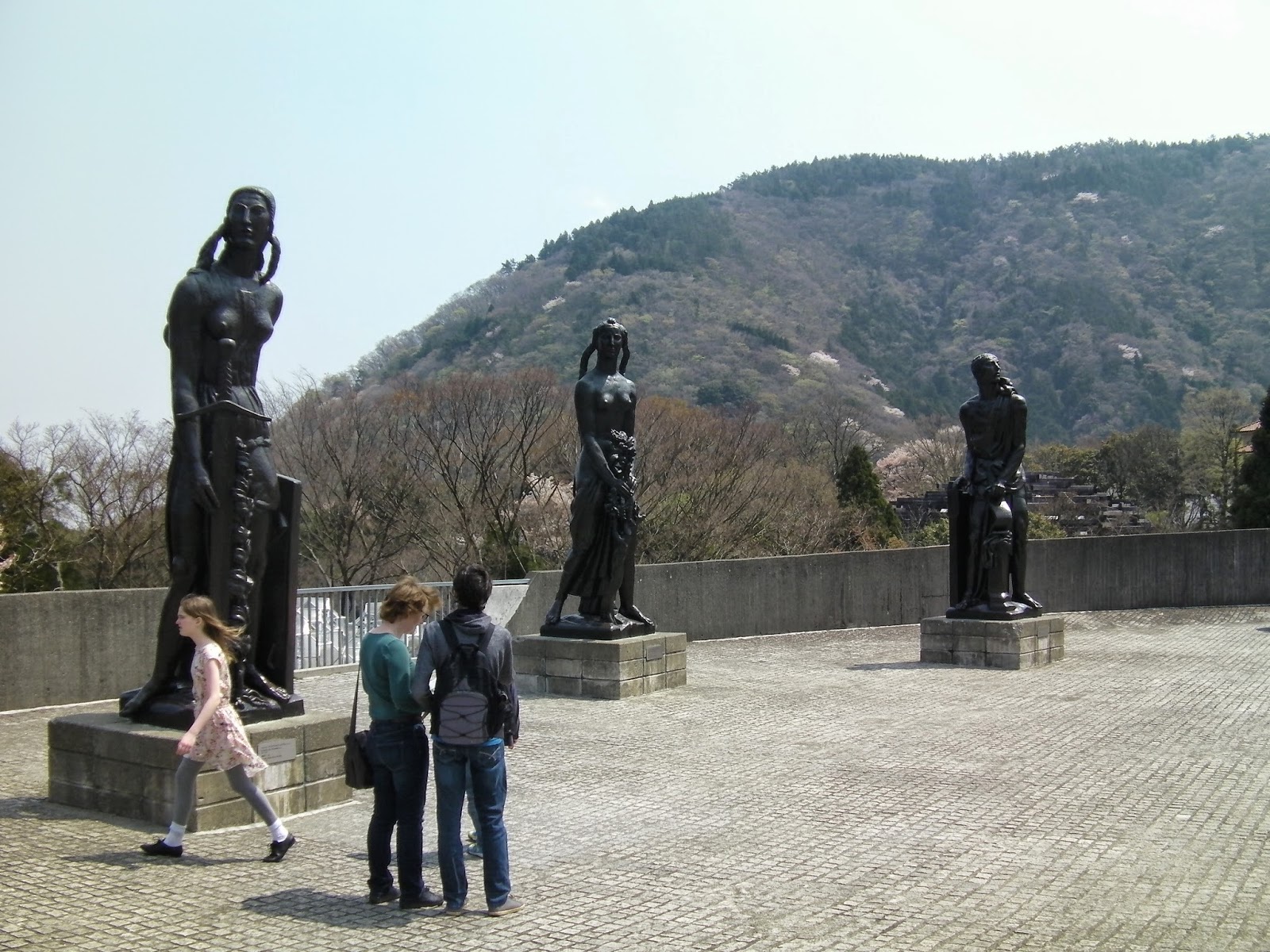
This marvellous museum is set in a stunning location, surrounded by hills, with a very impressive collection of sculptures (including several Henry Moores) on display in the grounds. It was very easy to spend several hours here, taking in the art and the scenery, and admiring the way the path had been arranged so as to set each work to a continually changing backdrop.


Lunch was taken at the cafe, after which Rachel and Imogen decided to sample the hot foot spa while James and Samuel climbed up the tallest building they could find.

One last detour to the gift shop, and we returned to the station to catch the train on to Sounzan where we then took the cable car up to the Hakone ropeway.
The ropeway is a 30-minute journey from Sounzan Station to Togendai Station, which nestles on the shore of Lake Ashi, with spectacular views of the lake, the rising volcanic fumes of Owakudani and (on clear days) Mount Fuji; alas this wasn't a clear day, but there was plenty to see and admire, not the least being the sulphurous emissions from the ground far below.


Hakone Ropeway


For the journey back, we discovered that Tonosawa station was a lot closer to our ryokan (which is the middle pin below) than Hakoneyumoto.


Dinner this evening was at the ryokan; yet again a sumptuous feast of many dishes, beautifully prepared. Tomorrow we leave Hakone for Kyoto.

Wednesday, 16 April 2014

Day 4: Ghibli, and on to Hakone

Our first experience of the takuhaibin (luggage forwarding) - all suitcases dispatched to the hotel in Kyoto -allowed us to proceed with only backpacks to the Studio Ghibli museum near the JR Mikita station today.

Tickets please
Mikita is a pretty suburb of Tokyo some 40 minutes from our hotel, and the weather today is just about perfect. A 15 minute walk from the JR station before we reach Kichijoji Avenue, in the shade of the tall green trees of Mitaka's Inokashira Park in which the museum is situated, and look who is here to greet us at the ticket booth.


The museum is set in a rambling house, and feels like a set from a Miyazaki film, all organised clutter. We collect our tickets (pleasingly, made of 35mm film cells from Ghibli productions - I get one from Spirited Away, much to my satisfaction), and make our way down a staircase lined with stained glass windows depicting ghibli designs.

There's a fascinating room full of working animations, from short films to the most extraordinary 3-D stroboscopic animation I've ever seen. Then we go to the Saturn Theatre to see today's short film presentation The Whale Hunt (fortunately this whale hunt is unlikely to draw the ire of Greenpeace!).

Ghibli Beer!
After that, lunch at the Ghibli cafe (with, for once, American-size portions of fried pork cutlet sandwiches and some excellent Ghibli beer - take that Disney!), then back to the museum to check out the terrific recreation of Miyaziki's work room (complete with realistic looking cigarette butts) with lots of truly wonderful original drawings. If only I could take a few away with me.

Outside the museum are some beautiful gardens (these are becoming a running theme during our trip to Japan), and there's always a chance you might bump into a character from one of the films.

Garden Character
A visit to the museum shop results in the acquisition of one mini totoro and one cat bus, plus some lovely postcards depicting scenes from My Neighbour Totoro, a charming origami kit for Totoros and cat buses, and several beautiful books.

Time for an ice cream, then a walk back to Mikita station (we speculate as to why the road surface has been made sparkly near junctions), and on to Shinjuku station via the JR Chou line to take the JR Yamanote line to Shinagawa station.

From here we took our first Shinkansen (bullet train) to Odawara; very long platform (the trains are very long), with demarcated places for queueing for each car, and Japanese people queue very properly both here and on the Tokyo Metro and other train stations.

Our Empty Shinkansen
Our Shinkansen arrives precisely on time (trains in Japan approach Swiss levels of punctuality), our carriage empty except for us; as so often in Japan things come in fives (5 seats across the train), very appropriate for us. All the staff on board bow as they enter the carriage, and bow again on leaving; getting rid of the reflex bow is something it will take us some time to do even after we've returned to England. We get off at Odawara.

At Odawara we got the bus for Hakone; we missed our stop and had to get another bus back in the opposite direction - fortunately again Inside Japan had supplied us with a 2 day bus pass and the buses run very regularly, so this was neither a long nor an expensive detour.

Family Time, Ryokan style


The main Hakone road is narrow and twisting, and many of the buildings are set away from the road on stone staircases up the hill behind the trees, so we had to find the correct staircase, but a very friendly local pointed in the right direction to the Ichinoyu Shinkan; our first taste of a traditional Japanese ryokan.

Do I dare to drink a...


The rooms are simple but beautiful, with tatami matting. Shoes are taken off at the door, and special shoes are provided for walking around the ryokan (but not on the tatami matting; that's barefoot or socks only). There are special plastic shoes for use in the toilet (Japanese toilets are always separate from the bathroom). Green tea and biscuits/buns are provided in our rooms, and there is a hot bath outside on the balcony of each room.

I acquire a taste for Japanese vending machine drinks here - there's rather a good grapefruit one (with bits), and also a mysterious one which I take to be peach.


Rachel and the children decide to dress in traditional yukata for dinner. I can't get into mine and am too shy to ask for larger one.


Dinner at the ryokan is lovely; many courses (fish, rice, pickled Ume plums, tofu etc.), all beautifully presented, washed down by several refreshing cold beers.


Back to our rooms for some well-earned rest, and I have some companions to watch over me while I sleep.

Tuesday, 15 April 2014

Day 3: Fish Market and Gardens

Still rising early because of the jet lag, we decided to have early breakfast at hotel and take our booked sushi breakfast as a sort of "brunch" later on. Lord Goodman eat your heart out.

Is that a turnip? Near Asakusa subway.
We caught the subway to Tsujikishijo, having topped up our IC transport passes (supplied by Inside Japan, these are like Oyster cards in London but allow you to travel hassle-free not only on the Tokyo subway, but also in most other Japanese cities).

Where to go?

Sushi Breakfast
We arrived at the fish market via one of the underground shopping arcades of which Tokyo is fond - maximising available space I suppose - this one fun to look at but featuring high-end goods which none of us were interested in shopping for. Although we weren't nearly early enough to catch the wholesale fish market itself in full flow, we enjoyed an excellent sushi breakfast at the Sushizanmai restaurant nearby (but what did the chefs say to greet us when we entered?). The best (and certainly  the freshest) sushi we'd ever had.

We all did various swaps with Imogen to ensure she had enough vegetarian options.

After our second breakfast of the day, we wandered through the bustling market, buying some red buns to eat later in the park. Then it was time to find a post office to try the ATMs to get some more Yen (really just to prove that we could, although as it transpired we already had more than enough cash to last the whole holiday, food and other daily living expenses not being as expensive as we had feared, helped by a favourable exchange rate;  but most transactions, including in restaurants and department stores seem to be in cash, so having plenty of cash on hand was important), and some stamps for our postcards home; the nice lady at the post office gave us a free postcard of the skytree for the kids.

Guess what this shop sells


Hama-rikyu gardens in Tsujiki was another example of the glories of Japanese garden architecture; a beautiful setting surrounded by high rises, with bridges, lakes (full of carp) and beauty all around. We sat on a bench near a very, very old tree and ate the buns we bought in the market.


A pity we'd missed the cherry blossom.


From the gardens we take a river boat to make our way back to Asakusa; plenty of good views on the journey, and a commentary in English as well as Japanese and at least one other language.


This evening we collect our JR rail passes; these indispensible items will provide us with 2 weeks' free travel on nearly all our train journeys around Japan, and even the ferry which we'll take later to Miyajima, and we go ahead and reserve seats for the journeys to Hakone tomorrow, and on from Hakone to Kyoto on Friday.

For supper this evening we went to Sasayonuki restaurant in the Taito district of Tokyo; not too far from the JR station so we found it fairly easily. As was usual with Japanese restaurants or hotels, it's really useful to have a photograph of what it looks like so that you can spot it from the street, as to untutored western eyes there are almost no clues as to the function of a building from the outside (and very few street names or building numbers).


We were greeted by a venerable Japanese gentleman who took our shoes, before proceeding to the tatami-matted interior. Unlike the Okonomiyaki restaurant the previous evening, this restaurant was obviously one for the locals and a little more formal, but we were made to feel welcome (as always in Japan) even if I am sure we committed all kinds of breaches of etiquette.

The restaurant specialised in tofu dishes, which was of great relief to Imogen as the word vegetarian apparently translates into Japanese as "eats fish".
This was high class tofu indeed, creamy and silky smooth, and vastly different from the coarser stuff available in the UK.

Everything was beautifully presented; there is a quotation from a Japanese poem "western food - every damned plate round", and the diverse array of dishes and plates was a sight to behold.


Back to the hotel for our last night in Asakusa, and a walk (or in Samuel's case, a run) through the now deserted shops around the temple.